Call for Contributions
Scope
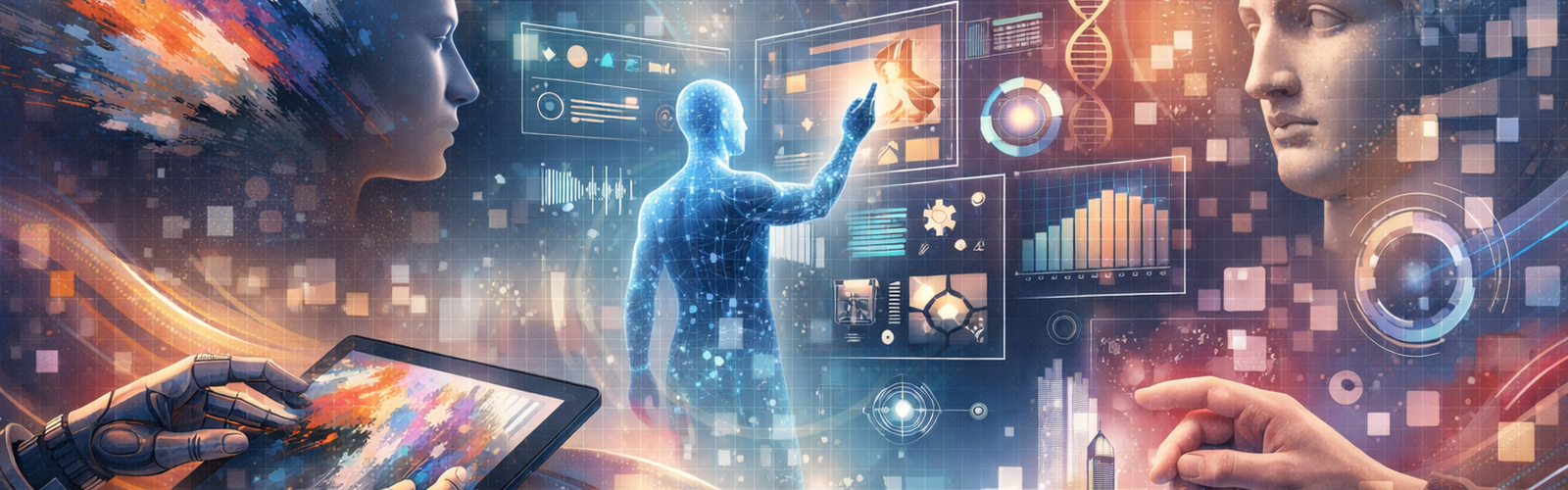
Artistic research is increasingly conducted through intelligent visual and interactive interfaces: generative image and sound tools, multimodal dashboards, interactive repositories, and mixed reality environments. These systems reshape how artists inquire, document, and share knowledge, redistributing agency among artists, AI models, datasets, platforms, and institutions.
In parallel, the rapid adoption of generative AI raises methodological, epistemic, and ethical challenges for artistic research. Questions of authorship and accountability, provenance and documentation, dataset and model governance, inclusivity, and sustainability become central—particularly as art academies and universities integrate AI-enabled tools into curricula and research ecosystems.
The workshop “Rethinking Artistic Research in the Age of AI: New Frameworks, HCAI Practices, and Challenges” (AVI 2026) explores how advanced visual interfaces and intelligent interaction paradigms can support artistic research in the age of generative AI. We invite contributions that present design cases, prototypes, platforms, and critical reflections on tools and environments created for and with artists and art schools. Of particular interest are interfaces and Human-Centred AI (HCAI) approaches that make agency visible and negotiable, foster critical and ethical stances toward AI, and enable learning ecosystems across academies and universities.
The workshop aims to create a venue where HCI researchers, designers, artists, and art educators can:
1) map current and emerging interaction paradigms for AI-supported artistic research;
2) discuss responsible and inclusive approaches to intelligent interfaces in artistic contexts; and
3) share examples of platforms, repositories, and tools that foreground artistic agency and creative self-actualization.
Topics
Topics of interest include, but are not limited to:
AI-based Art and Creativity
- Generative AI in artistic inquiry (image, sound, video, multimodal)
- Co-creation, mixed-initiative systems, and creative workflows
- Critical perspectives on automation, authorship, originality, and style
Human-Centred Interaction Paradigms and Tools for Art and Creativity
- Interfaces that surface agency, provenance, and model/data influence
- Explainability, legibility, and user control in creative AI tools
- Interaction techniques for prompting, steering, critiquing, and iterative refinement
- Design methods and participatory approaches with artists and art schools
Learning Ecosystems and Computer-Supported Cooperative Work
- Platforms, repositories, and documentation tools for artistic research
- Collaborative systems for studios, labs, archives, and classrooms
- AI literacy, critical making, and pedagogical tools in higher education
Diversity, Equity, and Inclusion and Responsible Design
- Inclusive and accessible creative AI interfaces
- Bias, harms, and mitigation strategies in creative datasets and models
- Governance, accountability, and institutional policies for AI in artistic research
- Sustainability and long-term stewardship of tools, datasets, and practices
Cultural Heritage and Digital Humanities
- Interfaces for digitization, restoration, interpretation, and public engagement
- Ethical curation, provenance, cultural rights, and participatory heritage
- Creative reuse, remix, and interpretive tools supported by AI
Health, Well-being, and Self-Actualization
- Interfaces supporting reflective practice, identity, and self-expression
- Community-based, care-oriented, or therapeutic creative technologies
- Methods and metrics to evaluate well-being impacts in creative AI contexts
Workshop format (tentative)
The workshop is planned as a half-day event combining a keynote, short talks, and a demo/poster session, followed by a closing discussion. We particularly welcome live demos of tools and platforms used in art academies and universities, including early-stage prototypes and speculative interfaces.
Submissions
We invite two kinds of submissions, addressing novel issues at the intersection of artistic research, HCI, and AI:
Demo Papers
Demo papers typically discuss exciting new work and tools, including early-stage prototypes, design probes, and platforms. Novel but significant proposals will be considered for acceptance in this category even if they lack extensive validation or a strong theoretical foundation. Applications to new domains and institutional contexts (e.g., academies/universities) are especially welcome.
Length: minimum 3 and maximum 5 pages (plus an unlimited number of pages for references).
Position / Discussion Papers / Extended Abstracts
Position/Discussion papers and Extended Abstracts describe novel and innovative ideas. They may also comprise analyses of currently unsolved problems, or review these problems from a new perspective, with the goal of guiding future research. We expect these contributions to motivate focused discussion, highlight critical assumptions, and identify open challenges and opportunities—possibly supported by quantitative and/or qualitative arguments.
Length: minimum 2 and maximum 4 pages (plus an unlimited number of pages for references).
Papers may range from theoretical works to system descriptions and practice-based research. We particularly encourage PhD candidates and early-stage researchers to submit their work. We also welcome contributions from industry and papers describing ongoing funded projects relevant to the workshop themes.
Position/Discussion/Extended Abstract and Demo paper submissions must be original work and may not be under submission to another venue at the time of review.
Review process and presentation
Submissions will be peer-reviewed using a single-blind model and evaluated according to originality, technical and/or practice-based content, clarity, and relevance to the workshop.
Accepted contributions will be included in the workshop program. Selected submissions will be presented as short talks; demos/posters will be presented via pitches and an interactive session. At least one author of each accepted contribution must register for AVI 2026 and attend the workshop.
Post-proceedings (planned)
Accepted peer-reviewed contributions will be published as post-proceedings in an open-access CEUR-WS.org workshop volume after the workshop. Demo and poster contributions may be included as extended abstracts in the same volume and/or made available through the workshop website and the P+ARTS online repository to ensure long-term visibility and accessibility.
Submission instructions
- Language: English
- File format: PDF
- Formatting: CEUR-WS two-column conference format (available as a compressed archive and as an Overleaf template CEUR-WS Overleaf template )
- Submission: Submit via EasyChair: https://easychair.org/conferences/?conf=ra2i
- Review model: single-blind
Important dates
- Paper submission deadline: March 29, 2026 (23:59 AoE)
- Paper acceptance notification: April 10, 2026 (23:59 AoE)
- Camera-ready deadline: TBA
- Workshop day: TBA (at AVI 2026)
Deadlines refer to 23:59 AoE (Anywhere on Earth) unless otherwise stated.
Contact
For questions, please contact the organizers at: claudio.pomo@poliba.it